From Tech Startup Fraud to Federal Prison Tips: The Reinvention Pattern of Kyle Sandler
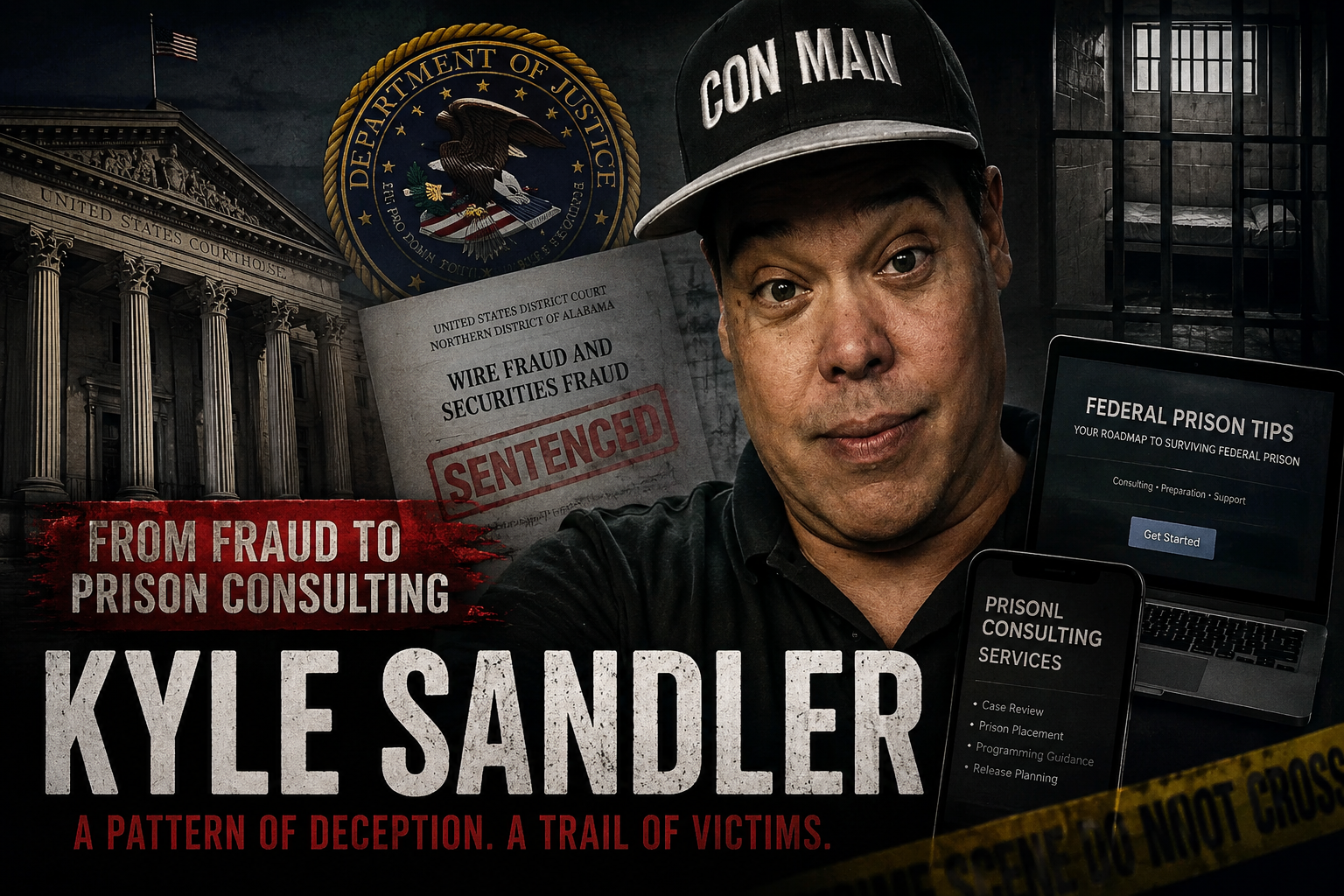
For many people, being publicly exposed for fraud would be enough to disappear from public life forever.
Most people, after being convicted of financial crimes, serving prison time, and becoming the subject of national media coverage, would likely retreat from the spotlight. They would avoid public attention, avoid attaching their name to new ventures, and attempt to quietly rebuild their lives.
But not everyone responds that way.
Some individuals appear unable to stop reinventing themselves. Even after public exposure, lawsuits, criminal convictions, and overwhelming criticism, they continue seeking attention, authority, influence, and new audiences to persuade.
That pattern is what makes the story of Kyle Sandler so important to examine.
This is not just a story about one failed business or one bad decision. Public records, federal reporting, investigative articles, and victim accounts suggest a much deeper pattern involving reinvention, manipulation, and repeated attempts to gain trust from vulnerable people.
And now, according to multiple public allegations and victim interviews, many believe the same behavioral patterns that once fueled a tech startup fraud operation have resurfaced again in the world of federal prison consulting. His new alleged fraud is under the company name Federal Prison Tips.
The Rise of “The Round House”
Years before becoming associated with federal prison consulting, Kyle Sandler gained attention in Opelika as the founder of a startup incubator called “The Round House.”
According to reporting by the Associated Press, Sandler presented himself as a wealthy entrepreneur and former Google executive who had arrived in Alabama to help build startups and mentor entrepreneurs.
He drove luxury vehicles. He spoke confidently about innovation, venture capital, and technology. He reportedly aligned himself with influential people in the startup world such as John McAfee, an early pioneer of internet security and quickly built credibility within the community.
Many people believed him.
According to the Associated Press investigation, Sandler allegedly convinced investors to pour substantial amounts of money into his ventures while cultivating the image of a successful tech visionary.
One of the most troubling allegations involved a young entrepreneur named Taylor Rosenthal, whose medical vending machine concept gained national media attention. The AP reported that Sandler allegedly fabricated aspects of major business interest surrounding the company, including fake communications and misleading claims involving large corporations.
The reporting painted a picture not just of financial deception, but of manipulation through storytelling, image, confidence, and perceived authority.
Eventually, federal authorities intervened.
According to the United States Department of Justice press release, Sandler was sentenced in federal court for wire fraud and securities fraud connected to his conduct involving investors.
The DOJ stated that Sandler fraudulently obtained money from investors through false representations and misuse of investment funds.
For many observers, that should have been the end of the story.
But it wasn’t.
The Reinvention
One of the most psychologically fascinating aspects of long-term fraud behavior is the ability some individuals have to continually reinvent themselves after exposure.
Rather than disappearing, they often return with a new audience, a new industry, and a new narrative.
In Sandler’s case, critics and alleged victims say that new arena became the world of federal prison consulting and prison preparation services.
This industry exists largely because people entering the federal prison system are often terrified, overwhelmed, and desperate for guidance. Families facing sentencing, incarceration, and separation are emotionally vulnerable and searching for hope, structure, and answers.
That vulnerability creates an environment where charisma and confidence can become incredibly powerful.
According to multiple recent public allegations, interviews, and investigative reporting, Sandler allegedly used that environment to position himself as an authority figure within the prison consulting space despite his criminal history and the widespread publicity surrounding his prior fraud case.
Reports published by The Human Intelligence Ledger include victim interviews, screenshots, claims of deceptive business practices, and accusations that people seeking legitimate help were misled financially and emotionally.
Another report, Florida Prison Consultants & $5 Million in Claims, explores additional allegations tied to the prison consulting industry and the broader concerns surrounding accountability within the space.
The allegations are serious.
But what stands out most is not simply the accusations themselves.
It is the apparent repetition of behavior.
Why Do Some Fraudsters Keep Going?
This question matters because it challenges how most normal people think.
Most individuals assume public shame stops bad behavior.
But for some personalities, exposure does not create retreat. It creates escalation.
Behavioral experts and psychologists have long discussed how certain individuals develop patterns involving:
While only trained professionals can diagnose personality disorders, repeated public behavior patterns can still be observed and analyzed.
One of the clearest patterns in many long-term fraud cases is something that could best be described as “identity addiction.”
The individual no longer simply wants money.
They want relevance.
They want admiration.
They want influence.
They want to be viewed as the expert, the insider, the visionary, or the savior.
The attention itself becomes part of the reward.
That may help explain why some publicly exposed fraudsters such as Kyle Sandler continue creating content, appearing online, launching businesses, giving interviews, and inserting themselves into public conversations even after overwhelming criticism and documented past misconduct.
In some cases, exposure may even strengthen the need for attention because controversy itself still provides relevance.
The internet has made this phenomenon far easier.
A person no longer needs universal trust to maintain influence. They only need enough people unfamiliar with their past to continue generating support, clicks, engagement, or customers.
The Federal Prison Consulting Problem
The federal prison consulting world is particularly vulnerable to abuse because it is largely unregulated.
Some consultants provide genuine value through lived experience, mitigation guidance, prison preparation, release planning, and emotional support.
Others, critics argue, may exploit fear, confusion, and desperation.
Families entering the federal system often:
do not know how sentencing works,
do not understand RDAP or First Step Act issues,
do not know how designation works,
and may be emotionally vulnerable enough to trust anyone who sounds confident.
That makes transparency critically important.
People seeking prison consulting services should always ask:
What are the consultant’s credentials?
What is their criminal history?
Are there public complaints?
Are there verifiable client outcomes?
Are promises realistic?
Is the consultant presenting opinion as fact?
Are they creating fear to drive sales?
Are they transparent about limitations?
No consultant should be immune from scrutiny simply because they speak confidently online.
A Community Speaking Out
One of the most notable developments surrounding Kyle Sandler in recent months has been the growing number of individuals publicly sharing their experiences.
Across YouTube, forums, articles, interviews, and social media discussions, former clients and critics have increasingly come forward alleging they were misled, financially harmed, or manipulated.
Whether every allegation is accurate is ultimately for evidence, courts, and public examination to determine.
But the volume of complaints itself is difficult to ignore.
Public accountability often starts the same way:
people stop staying silent.
Historically, many large fraud investigations only gained traction once victims realized they were not alone.
That is why documenting experiences matters.
If individuals believe they were misled or financially exploited, their voices deserve to be heard respectfully, factually, and transparently.
Final Thoughts
The story of Kyle Sandler is larger than one individual.
It raises broader questions about:
reinvention after fraud,
internet credibility,
manipulation through authority,
and the dangers vulnerable communities face when searching for help.
It also highlights an uncomfortable reality:
some people do not stop simply because they are exposed.
Sometimes the behavior continues until meaningful accountability intervenes.
For those who believe they were harmed financially or emotionally through interactions involving Kyle Sandler or related prison consulting operations, speaking out responsibly and documenting experiences may help others avoid similar situations in the future. GET HELP HERE!
Sunlight matters.
Transparency matters.
And vulnerable families navigating the federal prison system deserve honesty, accountability, and real guidance — not manipulation disguised as expertise.